

Struggling to win match-3 games despite trying your best? You're not alone. Many casual players find themselves stuck on levels, watching their win rates plummet due to random moves and poor planning. This guide delivers practical strategies proven to increase win rates by up to 30%, helping you dominate browser-based match-3 games through smart move planning, strategic power-up usage, and avoiding common pitfalls that drain your chances of success.
Table of Contents
- Prerequisites: What You Need Before Starting
- Step-by-Step Strategies for Effective Play
- Leveraging Power-Ups and Combos
- Common Mistakes and How to Avoid Them
- Expected Results and Success Metrics
- Discover More Match-3 Games and Tips at CorniGames
- Frequently Asked Questions About Winning Match-3 Games
Key Takeaways
| Point | Details |
|---|---|
| Plan ahead for combos | Thinking several moves ahead triggers cascades and boosts scores by 30%. |
| Save power-ups strategically | Reserve power-ups for critical moments and combine them for maximum board-clearing impact. |
| Avoid random moves | Random moves reduce win chances by 40%, so always analyze the board first. |
| Track your metrics | Monitor win rates, scores, and completion times to measure real improvement. |
| Focus on bottom matches | Prioritizing lower board matches creates automatic cascades that multiply your scoring opportunities. |
Prerequisites: What You Need Before Starting
Before diving into strategies, you need a solid foundation. Understanding your game's specific objectives is crucial because different match-3 games reward different approaches. Some demand reaching score targets within limited moves, while others require clearing specific tiles or collecting items. Your strategy shifts dramatically based on these goals.
Master the basic mechanics first. Match-3 games operate on simple principles: swap adjacent pieces to create three or more matching tiles. When tiles disappear, new ones fall from above, potentially creating cascades where multiple matches trigger automatically. These cascades are your secret weapon, often generating more points than planned moves.
Ensure your setup supports smooth gameplay. A stable internet connection prevents frustrating mid-game disconnects, especially on free online match-3 games that run in browsers. Check device compatibility too. Most modern browsers handle match-3 games well, but older devices may lag during complex animations, disrupting your timing.
Here's what impacts your approach:
- Score-based objectives require aggressive combo building and power-up chaining
- Limited-move puzzles demand precise planning with zero wasted swaps
- Time-based challenges favor quick pattern recognition over deep analysis
- Obstacle-clearing levels need targeted power-up deployment
Combos and cascades form the core mechanics you'll exploit. A combo happens when you match four or five tiles, creating special pieces with enhanced abilities. Cascades occur when gravity pulls new tiles into automatic matches after your initial move. Understanding this chain reaction separates winners from frustrated players stuck replaying levels endlessly.
Step-by-Step Strategies for Effective Play
Smart move planning transforms average players into consistent winners. Start every level by scanning the entire board for potential combo setups rather than making the first obvious match. Look for opportunities where one swap creates multiple matches simultaneously or sets up a cascade effect.
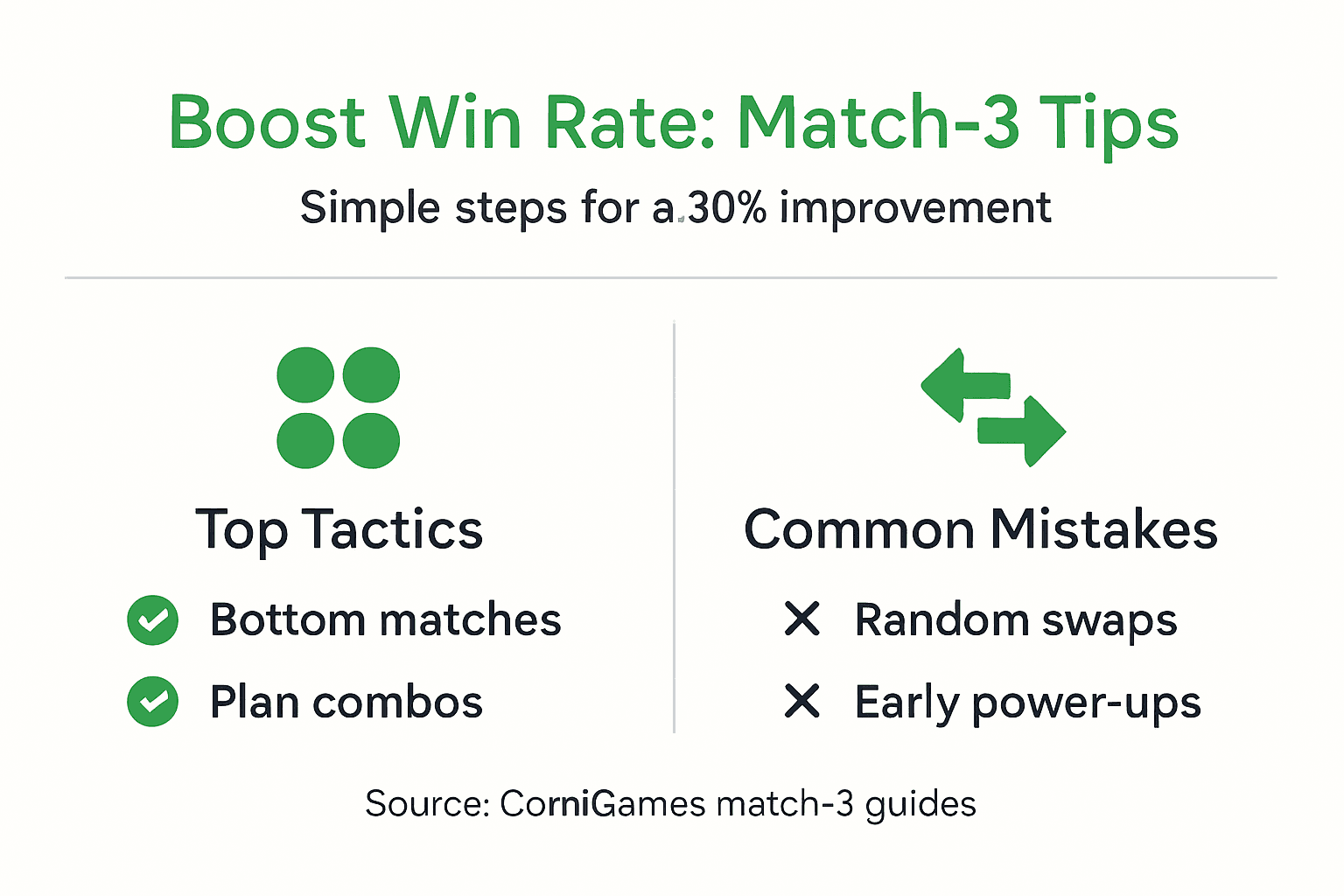
Planning moves ahead and creating combos increases win rates by up to 30% compared to reactive play. Here's your execution sequence:
- Survey the full board before any move, identifying special tile positions and potential combos
- Prioritize matches near the bottom third of the board to maximize cascading opportunities
- Create special tiles through four or five tile matches whenever possible
- Position special tiles adjacent to each other for devastating combo effects
- Reserve your undo function for correcting strategic errors, not simple misclicks
- Track remaining moves constantly in limited-move levels to pace your approach
Focus on bottom matches religiously. When you match tiles at the board's base, falling pieces create unpredictable cascades that often trigger multiple automatic matches. This single habit alone can double your average score per move. Top matches generate minimal cascade potential because fewer tiles drop afterward.

Pro Tip: In levels with 25 or fewer moves, avoid any swap that doesn't create a combo or special tile during your first 10 moves. This strict discipline preserves moves for the challenging endgame.
| Strategic Action | Rationale | Win Rate Impact |
|---|---|---|
| Bottom-focused matching | Triggers maximum cascades | +15-20% |
| Combo planning (2-3 moves ahead) | Maximizes special tile creation | +20-30% |
| Special tile positioning | Enables powerful combinations | +25-35% |
| Early move conservation | Preserves options for difficult phases | +10-15% |
Optimize those crucial opening moves. Limited-move levels become exponentially harder if you waste early swaps on low-value matches. Spend your first three moves setting up combos rather than clearing random tiles. This patience pays massive dividends when the board becomes more restrictive later.
The undo feature exists for strategic recovery, not perfection. Use it when you accidentally miss a superior combo setup or realize a move blocks a critical path. Don't waste it on minor scoring differences. Save undos for genuinely game-changing corrections on your match-3 game collection adventures.
Leveraging Power-Ups and Combos
Power-ups separate good players from great ones, but only when used strategically. The temptation to activate them immediately upon creation is strong. Resist it. Power-ups deliver maximum value when combined with other special tiles or deployed during critical board states where standard moves can't progress.
Save your special tiles for moments when the board becomes unfavorable. That striped candy or color bomb sitting pretty in the corner? It's your insurance policy against bad luck. Wait until you're genuinely stuck or can combine it with another power-up for exponential effect.
Combining multiple power-ups creates board-clearing explosions that single activations never achieve. A striped tile plus a wrapped candy clears massive sections simultaneously. Two color bombs together often clear 60 to 80 percent of the board instantly. These combinations turn impossible levels into easy victories.
Follow these power-up best practices:
- Create special tiles early but activate them late in each level
- Position two special tiles adjacent before activating for combination effects
- Reserve color bombs for moments when specific colors block your objective
- Use directional power-ups (striped tiles) to clear hard-to-reach obstacles
- Combine special tiles with upcoming cascades to multiply their clearing potential
Pro Tip: Set up a special tile combination first, then analyze whether activating it immediately serves your objective or if waiting one more move creates an even better opportunity. Patience transforms good power-up usage into exceptional results.
Timing matters enormously. Activating a powerful combo when you have 15 moves remaining wastes its potential. That same combo deployed with five moves left often secures victory. Think of power-ups as your endgame weapons, not opening moves. They're most valuable when standard approaches fail.
Strategic setup before activation multiplies impact. Before triggering that color bomb, scan for ways to create additional matches simultaneously. Maybe one standard swap positions more tiles for clearance. Maybe waiting for the next cascade generates a second special tile nearby. These micro-optimizations compound into major scoring advantages.
Common Mistakes and How to Avoid Them
Even experienced players fall into predictable traps that sabotage their win rates. Random moves without board analysis reduce win chances by 40% because they ignore combo potential and waste precious swaps on low-value matches. Every move should have clear strategic purpose.
Random moves decrease win chances by up to 40% compared to planned strategic play in match-3 games.
The biggest error? Focusing solely on immediate matches while ignoring setup opportunities. Players concentrating only on instant matches score 35% lower than those who think two or three moves ahead. Your current swap should always consider what the next board state enables.
Here are critical mistakes and their fixes:
- Making the first visible match without scanning alternatives: Always survey the full board before any move
- Activating power-ups immediately upon creation: Save them for strategic moments or combinations
- Ignoring bottom-board opportunities: Prioritize lower matches to maximize cascades
- Failing to track remaining moves in limited-move levels: Check your move count after every swap
- Creating special tiles without positioning them for combinations: Plan special tile placement two moves ahead
- Rushing through levels without learning patterns: Study failed levels to identify recurring obstacles
Poor power-up management kills countless winning opportunities. Using that color bomb on move five when you have 30 moves remaining? That's throwing away your most powerful tool when it matters least. Conserve premium power-ups for the challenging final phase when boards become restrictive and objectives seem impossible.
Thinking beyond immediate gratification transforms your gameplay. Yes, that three-tile match is available right now. But shifting your focus two rows down might set up a five-tile match that creates a color bomb. The delayed gratification approach consistently outperforms reactive matching by enormous margins.
Another subtle mistake involves ignoring chain reaction potential. Some swaps look mediocre in isolation but trigger cascades that generate multiple automatic matches. Train yourself to visualize what happens after tiles fall. This forward-thinking separates casual players from strategic experts who dominate leaderboards.
Expected Results and Success Metrics
Measuring improvement keeps you motivated and validates your strategic approach. Track your win rate as the primary success indicator. Calculate it simply: divide levels completed on first attempt by total levels attempted, then multiply by 100 for a percentage. Consistent strategy should push this metric above 60 percent within two weeks.
Score benchmarks vary by game, but tracking personal bests per level reveals real progress. If you initially scored 45,000 on level 12 and now hit 68,000, your combo execution improved dramatically. Compare scores against game-specific targets shown before each level starts.
Monitor moves remaining at level completion. Finishing with eight moves left instead of barely scraping by with one indicates more efficient play. This metric especially matters in limited-move puzzles where move conservation directly correlates with success.
| Metric | Starting Baseline | Target After 2 Weeks | Improvement Indicator |
|---|---|---|---|
| First-attempt win rate | 35-45% | 60-70% | Strategic planning working |
| Average score vs. target | 70-80% of target | 95-110% of target | Combo execution improving |
| Moves remaining | 0-2 moves | 5-8 moves | Efficient play developing |
| Level completion time | 4-6 minutes | 2-3 minutes | Pattern recognition sharpening |
Reduced completion times signal growing mastery. When you initially started, analyzing every board state took time. As pattern recognition develops, you spot combo opportunities instantly and execute faster. This speed comes from experience, not rushing. Never sacrifice strategic thinking for speed.
Set specific improvement goals to maintain momentum. Aim to increase your win rate by 5 percent weekly or reduce average completion time by 30 seconds per level. These concrete targets make progress tangible and keep you engaged with continuous improvement rather than plateauing after initial gains.
Ongoing practice with metric tracking sustains long-term skill development. Don't just play casually. After each session, review your performance data. Which levels took multiple attempts? What patterns caused failures? This analytical approach accelerates learning beyond simple repetition, turning gameplay into deliberate practice that builds genuine expertise.
Discover More Match-3 Games and Tips at CorniGames
Ready to put these strategies into action? CorniGames offers an extensive collection of free online match-3 games where you can immediately apply everything you've learned. No downloads, no registration, just instant access to dozens of match-3 challenges that test your newfound strategic skills.
Our platform provides more than games. You'll find expert tips, strategy guides, and a community of casual gamers sharing their winning approaches. Whether you prefer classic match-3 mechanics or innovative twists on the genre, CorniGames delivers fresh challenges that keep your skills sharp and your win rates climbing.
Start practicing these strategies today and watch your performance transform. The 30 percent win rate boost isn't theoretical. It's the measurable result players achieve when they replace random moves with strategic planning, save power-ups for critical moments, and focus on cascade-generating bottom matches.
Frequently Asked Questions About Winning Match-3 Games
How can planning moves ahead help?
Planning ahead lets you set up combos and cascades that multiply your scoring potential exponentially. When you think two or three moves forward, you position special tiles strategically and avoid wasting swaps on dead-end matches. This approach increases win rates by 30 percent compared to reactive play.
When should I use power-ups?
Save power-ups for challenging endgame situations or when you can combine multiple special tiles for maximum impact. Activating them early wastes their potential. The best timing is during difficult board states where standard moves can't progress your objective, typically in the final third of limited-move levels.
What common mistakes reduce win chances?
Random moves without board analysis cut win chances by 40 percent, while focusing only on immediate matches instead of combo setups lowers scores by 35 percent. Other critical errors include wasting power-ups early, ignoring bottom-board matches that create cascades, and failing to track remaining moves in limited-move puzzles.
How can I measure improvement?
Track three key metrics: first-attempt win rate (target 60-70 percent), average score versus level targets (aim for 95-110 percent), and moves remaining at completion (goal of 5-8 moves). Reduced level completion times also indicate growing pattern recognition and strategic efficiency. Review these metrics weekly to validate your progress.
Are there specific strategies for different match-3 games?
Yes, objectives dramatically shift optimal strategy. Score-based levels reward aggressive combo building and power-up chaining. Limited-move puzzles demand precise planning with zero wasted swaps. Time-based challenges favor quick pattern recognition over deep analysis. Obstacle-clearing levels need targeted power-up deployment on specific tiles blocking your progress.